Deception Island
Visiting Deception Island: its four landing sites and their limits, the volcano's eruption risk, the whaling-era ruins, hot-water bathing rules and the Baily Head chinstrap colony.
What is Deception Island, and can you visit it?
Deception Island is an active volcano in Antarctica's South Shetland Islands and one of the continent's most visited places: ships sail through a gap about 1,600 ft (500 m) wide into its flooded caldera. Tourists can land at four sites: Whalers Bay, Telefon Bay, Pendulum Cove and Baily Head. Whalers Bay drew over 25,000 people in 2023/24; Baily Head admits only ships of 200 passengers or fewer.
Facts checked October 14, 2026 against 14 sources.
Deception Island at a glance
- July: no trips
- August: no trips
- September: no trips
- October: no trips
- November: in season
- December: in season
- January: best
- February: best
- March: in season
- April: no trips
- May: no trips
- June: no trips
Best Season
- Type
- Island
- Location
- 62°57′S, 60°38′W
- Part of
- Antarctic Peninsula
- Season
- Most visitors and scientists are there from late November to early March, the months of greatest human presence; chinstrap chicks hatch around the new year.
- Best months
- January to February
- Getting there
- By ship, through Neptunes Bellows, a gap about 1,600 ft (500 m) wide; the island is in the South Shetlands, just south of the Drake Passage, on many Antarctic Peninsula voyages.
- Wildlife
- About 70,000 pairs of chinstrap penguins, some 50,000 of them at Baily Head; fur and other seals on the beaches; humpback whales offshore from late December.
- Landings
- Four visitor sites, at most 100 people ashore at a site at a time; Baily Head only for ships of 200 passengers or fewer; keep 33 ft (10 m) from wildlife; ships should not enter Port Foster at orange alert.
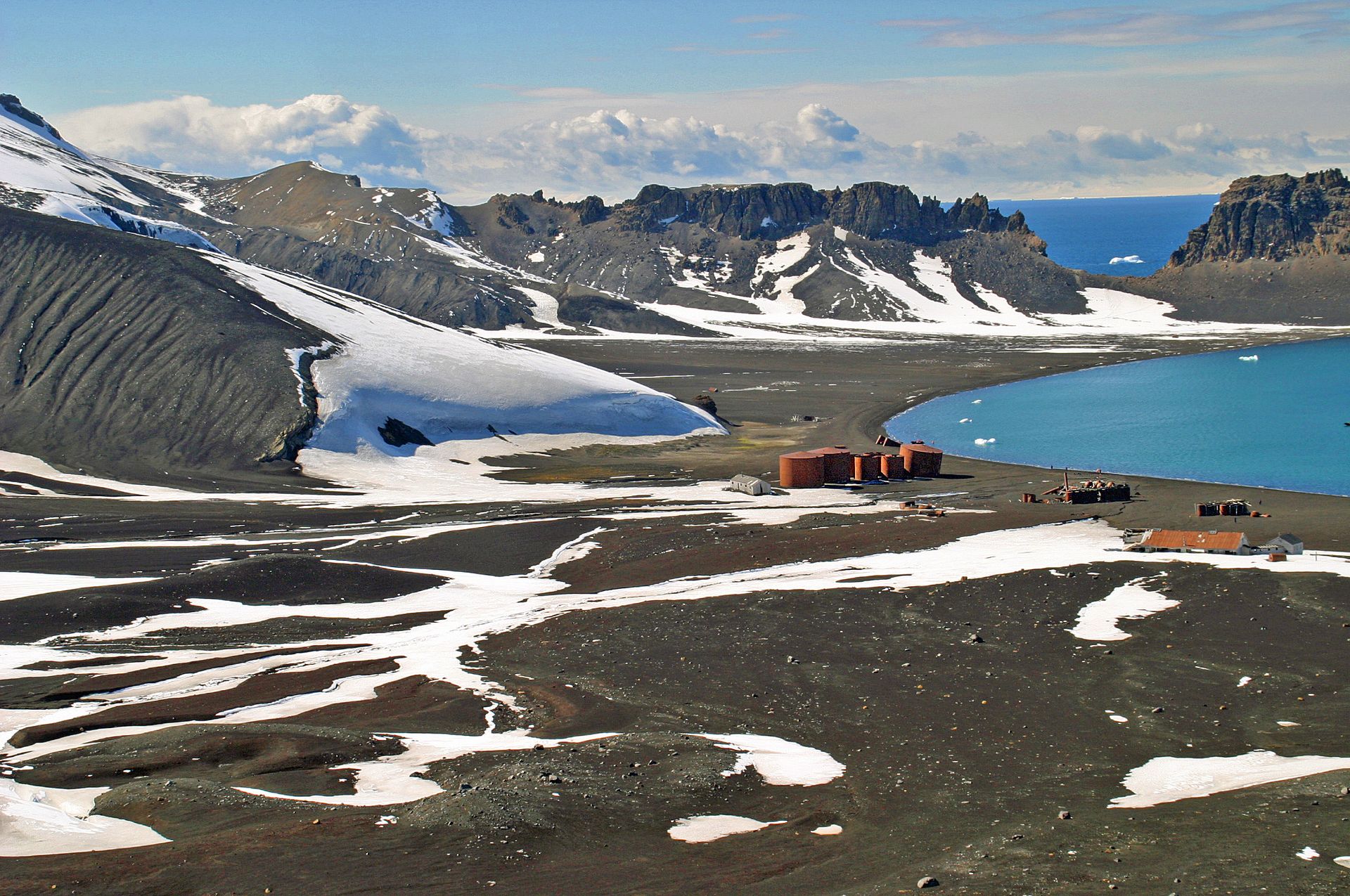
Deception Island is an active volcano in the South Shetland Islands, about 9 miles (15 km) across, whose collapsed summit has flooded to form a sheltered harbor, Port Foster.12 It is one of the few places in the world where ships can sail straight into the middle of a restless volcanic caldera, and one of the most visited tourist sites in Antarctica.2 It lies just south of the Drake Passage, off the tip of the Antarctic Peninsula, and tens of thousands of visitors land here each season.3
Why is it called Deception Island?
Because from the sea it looks like an ordinary island and hides a harbor inside. The official gazetteer of Antarctic place names says the name was first recorded by Palmer, an American, in 1820, and refers to "the deceptive nature of this ring-shaped island with its central harbour, a breached and drowned volcanic crater".4
The only way in is Neptunes Bellows, a narrow, shallow gap about 1,600 ft (500 m) wide in the south-east side of the ring. Ships must announce on VHF channel 16 when and in which direction they will pass through, and captains must ask the island's research stations about current volcanic activity before entering Port Foster.2 The stern of the whale catcher Southern Hunter, which foundered on Ravn Rock in the Bellows in 1956, still lies on the beach west of Entrance Point.2
Can you visit Deception Island?
Yes. Tourists may land at four sites, Whalers Bay, Telefon Bay, Pendulum Cove and Baily Head, and each has its own Antarctic Treaty guidelines. Visits to the two research stations need the station leader's prior agreement, and visits elsewhere on the island are discouraged.2
| Site | What you see | Ship limit | Ships a day | Visitors in 2023/243 |
|---|---|---|---|---|
| Whalers Bay | Ruins of the Hektor whaling station, the whalers' cemetery site and British Base B, together Historic Site and Monument No. 715 | 500 on board | 3, no more than 2 over 200 passengers | over 25,000 |
| Telefon Bay (east) | Volcanic craters up to 150 ft (45 m) deep, in a valley reshaped by the 1967 eruption6 | 500 on board | 3, no more than 2 over 200 | almost 11,000 |
| Pendulum Cove | Geothermally heated water and the ruins of Chile's Presidente Pedro Aguirre Cerda station7 | 500 on board | 3, no more than 2 over 200 | almost 3,000 |
| Baily Head | A chinstrap penguin colony in a natural amphitheater8 | 200 on board | 2 | almost 1,000 |
Whalers Bay drew 184 landings from 54 vessels in 2023/24,3 and about 25 times as many visitors as Baily Head. The gap is down to rules and surf. Baily Head admits only ships with 200 or fewer passengers aboard and two ships a day, its landing beach faces the open Bransfield Strait, and the guidelines warn that heavy swell and surf can make landings impossible.8
That cap decides who gets there. In 2025-26, Sylvia Earle, National Geographic Endurance, Hondius and Ultramarine each averaged fewer than 200 passengers per Peninsula voyage, while Fridtjof Nansen averaged 384 and Viking Octantis 366, by our division of IAATO's figures.9 On a typical sailing, the larger two cannot land at Baily Head.
What happened on Deception Island?
Sealing and whaling, a secret wartime base, and eruptions that destroyed two research stations.2 The management plan adopted by the Antarctic Treaty nations calls the remains at Whalers Bay the most significant whaling remains in Antarctica.2
| Year | What happened |
|---|---|
| 1820 | The name is first recorded; sealers chart the island in 1820 and 18214 |
| 1828 | Henry Foster of HMS Chanticleer makes magnetic observations with pendulums at what becomes Pendulum Cove2 |
| 1906 to 1907 | Norwegian captain Adolfus Andresen of the Sociedad Ballenera de Magallanes begins whaling, with factory ships anchored in Whalers Bay |
| 1908 | The whalers' cemetery is established |
| 1912 to 1931 | The Norwegian company Hektor runs a shore whaling station in Whalers Bay |
| 1943 to 1944 | Britain sets up Base B in the abandoned station during the secret wartime Operation Tabarin |
| 1955 | Chile opens the Presidente Pedro Aguirre Cerda station at Pendulum Cove |
| 1956 | The whale catcher Southern Hunter founders in Neptunes Bellows |
| 1967 to 1970 | Eruptions destroy the Chilean station (1967 and 1969); in 1969 a mud and ash flow wrecks Base B, and the cemetery is partly buried and partly swept away |
Sources for the table from 1906 onward: the island's management plan, including its conservation strategy for Whalers Bay.2
The whalers' cemetery is the starkest reminder of that era: when the 1969 eruption hit, it held 35 graves and a memorial to ten men lost at sea, only one of whose bodies was ever recovered.2
Whalers Bay is fragile and hazardous. Entering buildings, boilers or tanks is prohibited, you must stay at least 16 ft (5 m) from the wooden buildings, materials containing asbestos are present, and in high winds the whole area should be avoided because of flying debris.5
Is Deception Island still an active volcano?
Yes. It erupted in 1967, 1969 and 1970, went through episodes of unrest in 1992, 1999 and 2014 to 2015, and the island's management plan says a future eruption is likely.2 Port Foster itself formed in a violently explosive eruption, possibly less than 10,000 years ago, that emptied around 7 to 14 cubic miles (30 to 60 cubic km) of magma and collapsed the summit.2
The volcano is watched closely while people are there. Spanish and Argentine scientists record its activity continuously for about four months each summer, typically from late November to early March. Background activity runs to several hundred small volcanic earthquakes a month, and at Caliente Hill the ground reaches 176 to 212°F (80 to 100°C) just 4 to 16 inches (10 to 40 cm) down.2 During the 2014 to 2015 unrest the alert level went to yellow on February 17, 2015, and Spain closed its Gabriel de Castilla station on February 24.2
Alerts run on four colors: green (no eruption expected, the normal state), yellow, orange and red.10 The visitor code of conduct recommends that ships not enter Port Foster at orange,2 so a raised alert can take Deception off your itinerary.
Can you swim in the hot springs at Deception Island?
Sometimes, where hot water mixes with the cold sea, but it is not a hot spring pool. Water above 158°F (70°C) has been recorded at Pendulum Cove, so the site guidelines tell expedition staff to choose a bathing area where the hot water mixes with cooler sea water and tell bathers to wear shoes or boots to avoid scalding their feet.7 Digging bathing pits is not allowed at Pendulum Cove or at Whalers Bay.75 Whether a swim is offered depends on your operator, the site chosen and the conditions on the day.
Pendulum Cove has tighter group rules than most sites: one guide for every 15 visitors rather than 20, groups of fewer than 15 near the ruined Chilean station, and a 49 ft (15 m) buffer around the ruins because of dangerous holes.7
Does anyone live on Deception Island?
No one lives there year-round. Argentina's Decepción station (founded in 1948) and Spain's Gabriel de Castilla station (built in 1989) are staffed only in the southern summer, mostly for volcano monitoring and studies of seafloor life.3 The island is managed as Antarctic Specially Managed Area No. 4 by a group of six Treaty nations: Argentina, Chile, Norway, Spain, the UK and the US.3
It is a cold place to work. The mean annual temperature is 27°F (−3°C), recorded extremes run from 52°F to −18°F (11°C to −28°C), and the prevailing winds blow from the northeast and the west.11
What wildlife lives on Deception Island?
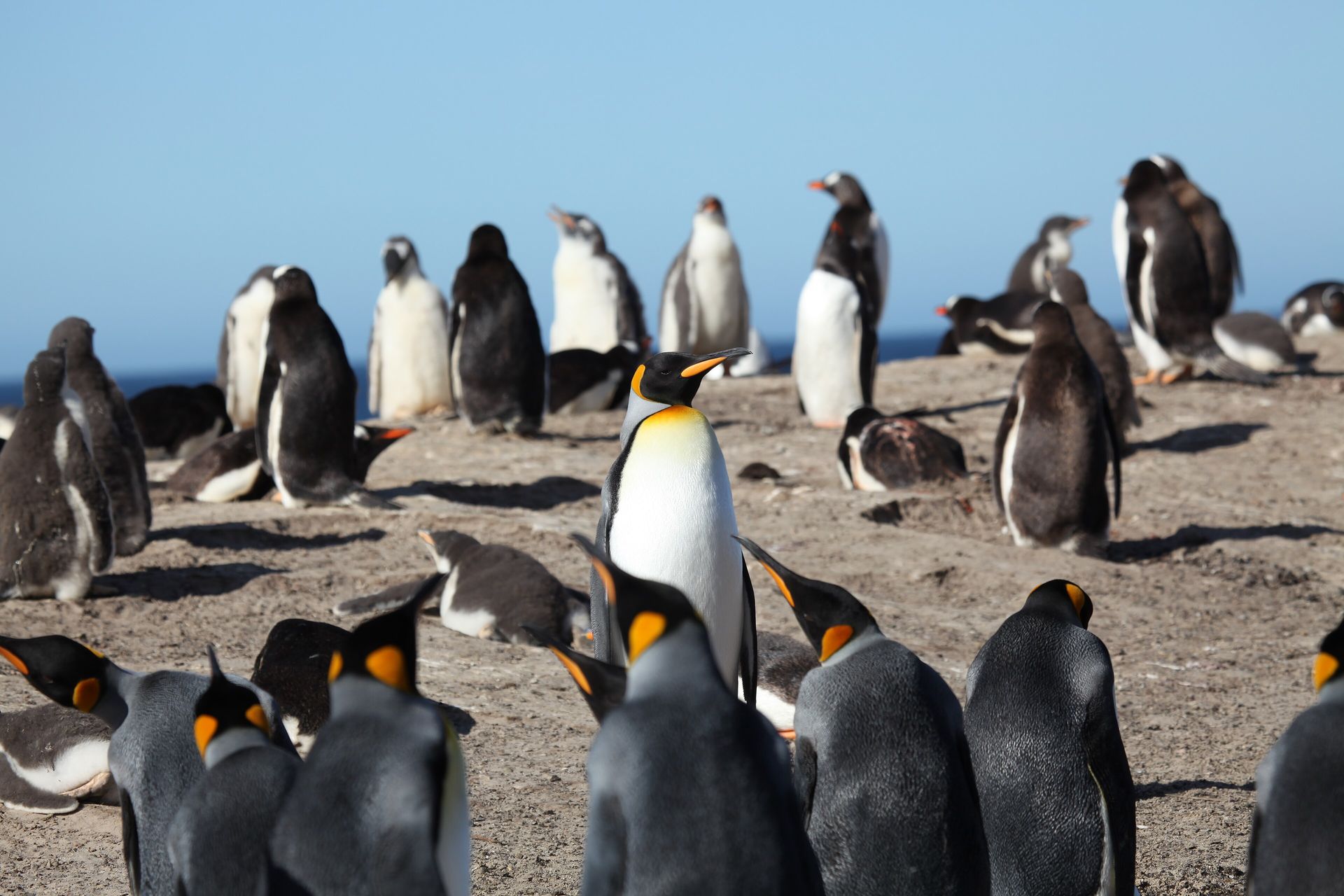
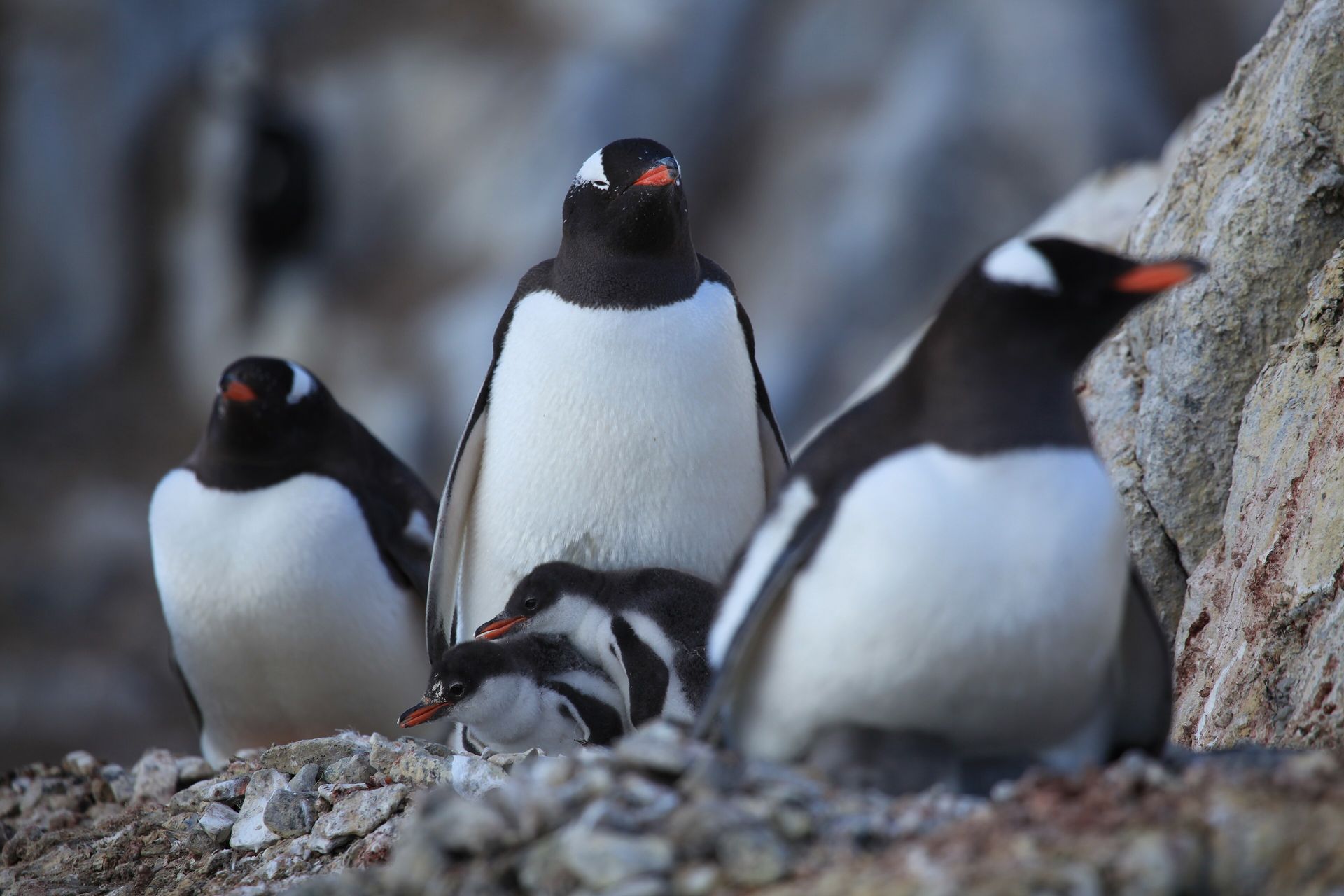
Chinstrap penguins, above all. The island has around 70,000 breeding pairs, and the largest colony, at Baily Head, held about 50,000 pairs in the latest survey, from the 2011/12 season.2 That colony has fallen by about half since the 1986/87 census, and the management plan says the island's chinstrap decline is probably due to the effect of climate change on the krill they eat.2 The Treaty's site guidelines, last revised in 2013, describe Baily Head as the Antarctic Peninsula's largest chinstrap colony.8
Chinstraps lay two eggs in late November and incubate them for 33 to 36 days, so chicks appear around the turn of the year and fledge at 7 to 8 weeks.12 A January or February visit is the time to see chicks. Our penguin species page compares chinstraps with the other Peninsula penguins.
Nine bird species breed on the island, among them brown and south polar skuas, kelp gulls, cape petrels and snowy sheathbills. No mammals breed there, but fur, Weddell, crabeater, elephant and leopard seals haul out on its beaches, about 500 fur seals are normally on the beach between Entrance Point and Collins Point, and humpback whales are routinely seen feeding off the coast from late December.2
What are the rules for visiting Deception Island?
Keep 33 ft (10 m) from birds and seals, and where practicable 49 ft (15 m) from fur seals. That is the general rule in the island's own visitor code of conduct, adopted with its management plan in 2019, and it applies at all four sites.2 It doubles the usual Antarctic minimum of 16 ft (5 m), and the Treaty's general visitor guidelines tell you to follow any site-specific distances.13 The older 2018 site guidelines for Whalers Bay and Telefon Bay still say 16 ft (5 m),56 but 33 ft (10 m) is the figure to follow anywhere on Deception. The other rules that affect visitors:
- No more than 100 passengers ashore at a site, with one staff member for every 20 (15 at Pendulum Cove).27
- Stay at least 66 ft (20 m) from volcano monitoring equipment, which is marked with red flags.2
- At Baily Head, walk in guided groups of no more than 15, and no one is ashore from 10 p.m. to 4 a.m.8
- Do not hike between Whalers Bay and Baily Head: the route damages Antarctica's largest recorded stand of Antarctic pearlwort, a flowering plant.5
- Kroner Lake, the only geothermal lagoon in Antarctica, sits in a specially protected area that you may not enter without a permit.1
- Because of bird flu, do not sit, kneel or lie down, and do not put bags on the ground.14
Is Deception Island worth it, and who should skip it?
Go for the whaling history and the strangeness of sailing into a volcano: Whalers Bay is where most ships land, and it is worth the stop on those terms.3 If penguins are the point, Baily Head is the prize, but only on a ship carrying 200 or fewer and only when the swell allows, so do not book a trip on the strength of it. And do not count on Deception at all if you are traveling in a season of volcanic unrest: a raised alert can keep ships out of Port Foster. Travelers who want penguins on every landing should weigh the gentoo and Adélie sites on the Peninsula itself, listed on our Antarctic Peninsula page.
Voyages that visit Deception Island
Landings depend on weather and ice, so no operator can promise a specific site.
Antarctica: Discovery and Learning Voyage (Hondius)
Oceanwide Expeditions · Hondius · 11 days · from Ushuaia, Argentina · Sail both ways · December to January
from $9,650about $877 a day
ViewAntarctica: Polar Circle, Deep South Discovery Voyage (Ortelius)
Oceanwide Expeditions · 13 days · from Ushuaia, Argentina · Sail both ways · March
from $11,000about $846 a day
ViewWeddell Sea: In Search of the Emperor Penguin, incl. helicopters (Ortelius)
Oceanwide Expeditions · 11 days · from Ushuaia, Argentina · Sail both ways · November to December
from $12,100about $1,100 a day
View
Lowest published price per person in the operator's currency, checked October 14, 2026. Taxes, flights and single supplements vary.
Wildlife at Deception Island
Plan the trip
Sources
- 1.Deception Island: Introduction, Deception Island Management Group. Accessed October 14, 2026.
- 2.Management Plan for Antarctic Specially Managed Area No 4, Deception Island (Measure 10 (2019)), Secretariat of the Antarctic Treaty. Accessed October 14, 2026.
- 3.Deception Island: Current Activities, Deception Island Management Group. Accessed October 14, 2026.
- 4.Deception Island (Gazetteer of the British Antarctic Territory, ID 108460), UK Antarctic Place-names Committee, via the SCAR Composite Gazetteer of Antarctica (Australian Antarctic Data Centre). Accessed October 14, 2026.
- 5.Site Guidelines for Visitors: Whalers Bay, Deception Island, Secretariat of the Antarctic Treaty. Accessed October 14, 2026.
- 6.Site Guidelines for Visitors: Telefon Bay (East), Deception Island, Secretariat of the Antarctic Treaty. Accessed October 14, 2026.
- 7.Site Guidelines for Visitors: Pendulum Cove, Deception Island, Secretariat of the Antarctic Treaty. Accessed October 14, 2026.
- 8.Site Guidelines for Visitors: Baily Head, Deception Island, Secretariat of the Antarctic Treaty. Accessed October 14, 2026.
- 9.IAATO Overview of Antarctic Vessel Tourism: The 2025-26 Season, and Preliminary Estimates for 2026-27 (ATCM 48 IP 200 rev. 1), International Association of Antarctica Tour Operators (IAATO). Accessed October 14, 2026.
- 10.Deception Island: Volcanic Activity, Deception Island Management Group. Accessed October 14, 2026.
- 11.Deception Island: Climate, Deception Island Management Group. Accessed October 14, 2026.
- 12.Chinstrap penguin, Australian Antarctic Division (Australian Antarctic Program). Accessed October 14, 2026.
- 13.General Guidelines for Visitors to the Antarctic (ATCM), English poster, Antarctic Treaty Consultative Meeting (poster published by IAATO). Accessed October 14, 2026.
- 14.How can I help? (avian influenza rules for visitors), International Association of Antarctica Tour Operators (IAATO). Accessed October 14, 2026.